

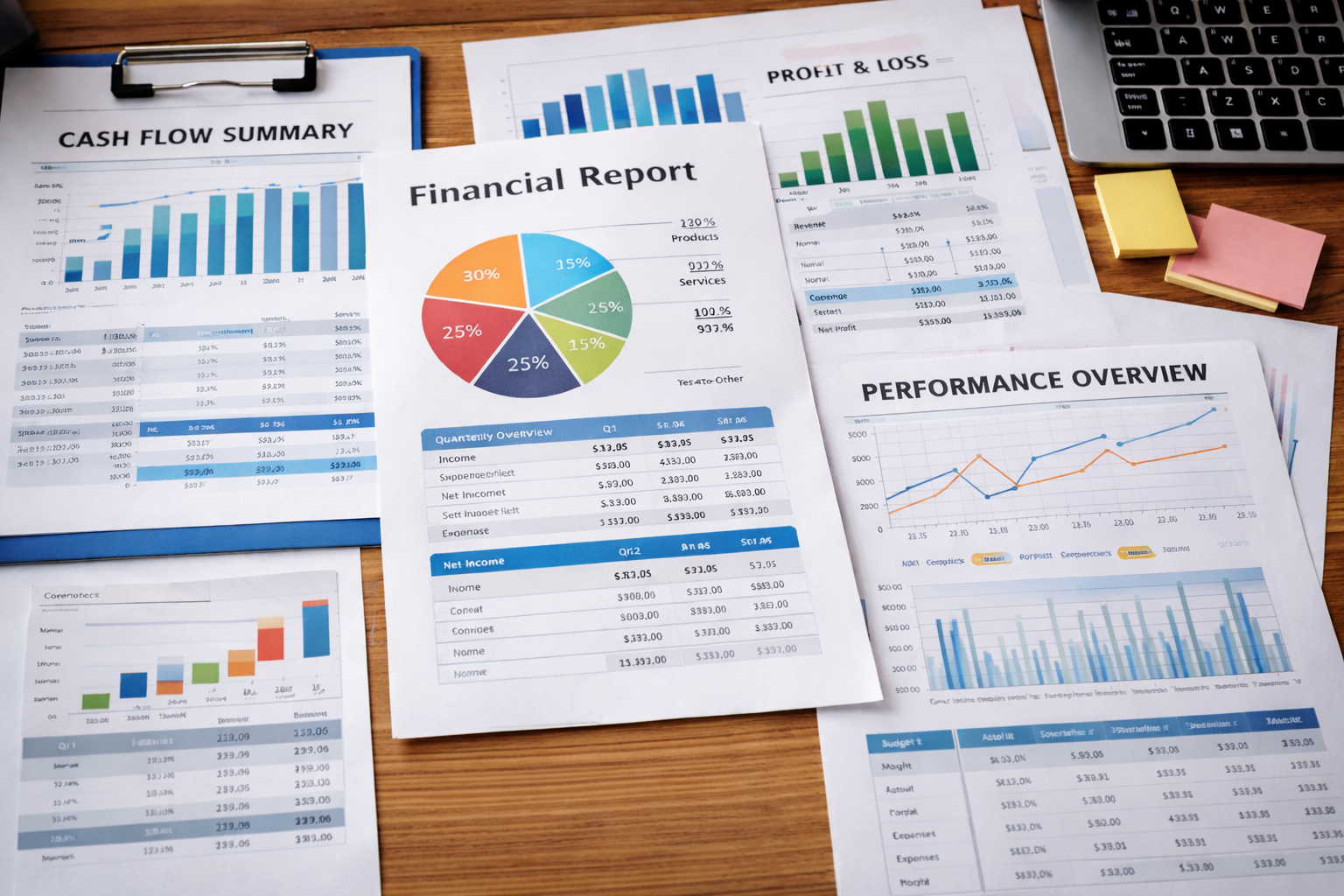
The Power Behind the Numbers: Why Internal Financial Reporting Drives Smarter Business Decisions
For many small and mid-sized businesses, financial reporting is treated as a compliance exercise—something prepared for tax filings, lenders, or year-end reviews. But the most resilient and scalable companies understand a deeper truth: internal financial reporting is not about looking backward—it’s about steering forward.
In an environment shaped by rising interest rates, tighter labor markets, and increased competition, especially across California, businesses that rely on timely, accurate internal reporting consistently outperform those that operate on intuition alone.
Why Internal Financial Reporting Matters More Than Ever
According to a 2024 study by QuickBooks and ESG Research, nearly 70% of small business owners say they lack real-time visibility into their financial performance, yet companies that review internal financials monthly are 30% more likely to achieve revenue growth year over year.
Internal financial reporting transforms raw data into operational intelligence. It allows leadership to understand not just what happened, but why—and what to do next.
In California, where operating costs are higher and margins are often tighter, this level of clarity can mean the difference between sustainable growth and constant firefighting.
Moving Beyond the Income Statement
Many businesses rely heavily on profit and loss statements alone. While essential, they only tell part of the story. Strong internal reporting frameworks typically include:
Cash flow tracking to ensure liquidity and resilience
Balance sheet analysis to understand long-term financial health
Department-level reporting to evaluate performance across teams
Trend analysis to identify early warning signs or growth opportunities
The U.S. Bank Small Business Finance Survey found that 82% of businesses that failed cited cash flow mismanagement as a primary cause—a risk that robust internal reporting significantly reduces.
Data as a Decision-Making Tool
Internal financial reports should inform daily and strategic decisions, not sit untouched in a folder. When used correctly, they help leaders answer critical questions:
Which services or products are truly profitable?
Where are costs creeping up unnoticed?
Can we afford to hire, expand, or invest right now?
How resilient are we if revenue dips next quarter?
Harvard Business Review reports that data-driven organizations are 23 times more likely to acquire customers and 6 times more likely to retain them. Financial data is the backbone of that advantage.
Reporting Frequency Shapes Outcomes
One of the most overlooked aspects of internal reporting is cadence. Annual reviews are insufficient. Quarterly reporting helps, but monthly—or even rolling—reviews are where real control emerges.
Businesses that conduct monthly financial reviews improve forecasting accuracy by over 25%, according to CPA Trendlines. This enables faster course correction and more confident decision-making, especially in volatile markets.
For growing companies, frequent reporting also creates discipline—forcing alignment between financial reality and operational ambition.
Financial Transparency Builds Stronger Teams
Internal financial reporting isn’t just for executives. When shared appropriately, it strengthens organizational trust and accountability. Teams that understand financial goals tend to make better day-to-day decisions.
Gallup research shows that companies with high employee engagement are 21% more profitable, and financial transparency plays a significant role in that engagement. When employees understand how their actions impact the bottom line, ownership and performance rise.
Technology Is Raising the Bar
Modern reporting tools have made sophisticated financial insights accessible to SMBs. Cloud-based accounting platforms, dashboards, and automation now allow businesses to generate accurate reports faster and with fewer errors.
In California, where compliance requirements and payroll costs are complex, automation reduces risk while freeing leadership to focus on strategy instead of spreadsheets.
The businesses gaining ground are not those with the most data—but those with the clearest view of it.
Financial Reporting as a Growth Discipline
At its core, internal financial reporting is about discipline. It brings structure to ambition and evidence to intuition. Companies that grow sustainably don’t guess their way forward—they measure, analyze, and adjust.
For small and mid-sized businesses looking to scale, attract capital, or navigate uncertainty, strong internal reporting isn’t optional. It’s foundational.
The numbers are already telling a story. The question is whether leadership is listening.







 Google